


Last month we headed to Alexandria, Virginia USA for the 1st OCUDU Ecosystem Developer Summit, hosted by Virginia Tech from 20 to 22 October. The OCUDU project, from Linux Foundation, aims to produce a fully functional open-source RAN software stack, with a focus on the DU and CU network functions. This was the first opportunity for the entire OCUDU developer community to meet and collaborate face-to-face for 3 full days.
Ericsson Software Technology joined the OCUDU project as founding premier member in March 2026, and our developer team started contributions during the summer. Three of us from EST attended the summit, and we were joined by some other colleagues from across Ericsson. We were invited to present a demo of some of our work to date and offered the opportunity to participate in an expert panel discussion session.
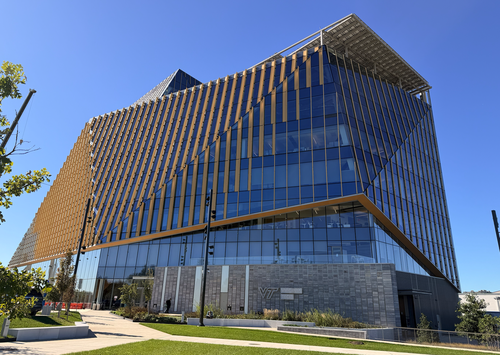
The Summit
It was co-hosted by the Linux Foundation, the Commonwealth Cyber Initiative and Virginia Tech, with developers, operators and researchers all in the one building. Day one covered project status and the PHY roadmap, the middle day got into orchestration and security testing, and the last day leaned heavily into use cases, especially integrated sensing and communication (ISAC).
Since this was the first OCUDU Dev summit, there were several introductory sessions, with particular focus on describing the objectives of the project, ongoing work, short-term and medium-term plans. There was also a strong research focus at times, with a lot of contribution from academia, industrial research organisations and test labs. They showed their ongoing and planned work, and what they had already achieved with existing OCUDU stack. Some of the best conversations happened with these researchers, especially over lunch and between talks. In total there were 6 keynote talks, 2 panel sessions, 16 community presentations, and 21 demos and posters.
Our Demo: “Test Reporting - Knowing what changed!”
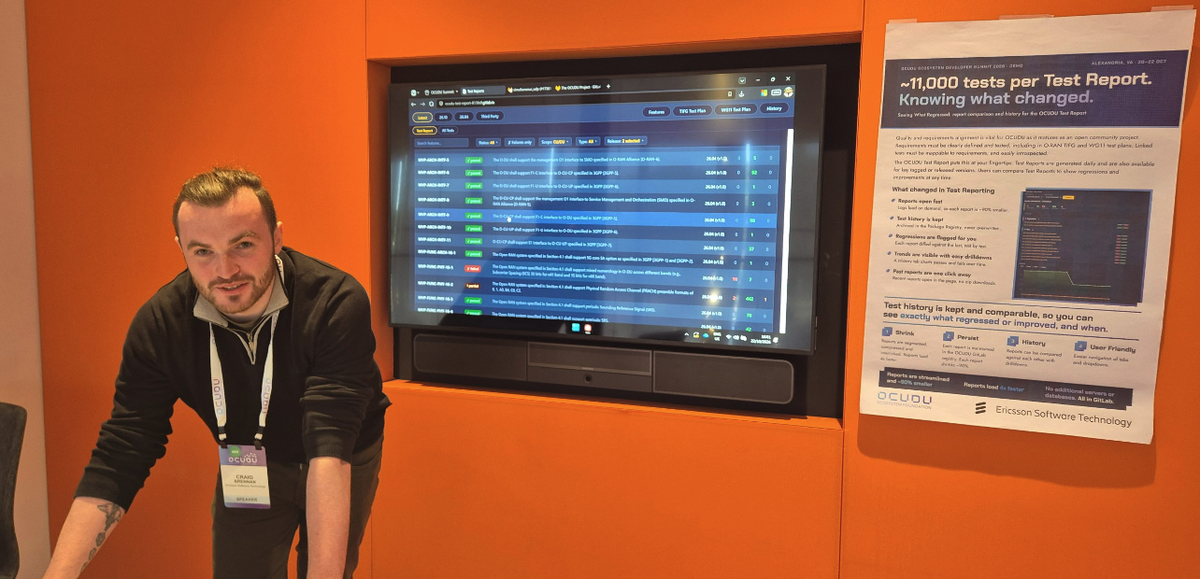
Craig Brennan, Open-RAN open-source developer in EST, demoed our recent work to fully redesign and rebuild the OCUDU Test Reporting tool. Craig’s demo ran during every coffee and lunch break for the 3 days, with great engagement and discussions with nearly all attendees.
The OCUDU Test Reporting tool generates comprehensive daily reports, with about 11,000 tests currently, with tests mapped to requirements including the O-RAN TIFG and WG11 test plans. Until recently each report was a single snapshot, so you could see what passed and failed for a given run, with little or no history or result comparisons.
Now every OCUDU Test Report is archived and selectively compared against the previous runs, test by test, with regressions and fixes flagged, and a new History tab charting results over time. The backend data storage, processing and front-end had to be significantly redesigned, and now logs are load on demand. Test reports are around 90% smaller and four times faster to open, and the entire thing is executed and hosted within GitLab with no extra servers or databases.
The demo itself was simple, pick two runs, hit compare and drill down into the history and logs to find what had regressed. There was a lot of interest from the community to understand how the toolset could be reused to present their test results, especially those from 3rd party test labs, or to reuse outside of OCUDU. We now have loads of new users and some great ideas on our backlog!
The Panel Session: “The Road Ahead for the OCUDU Community”
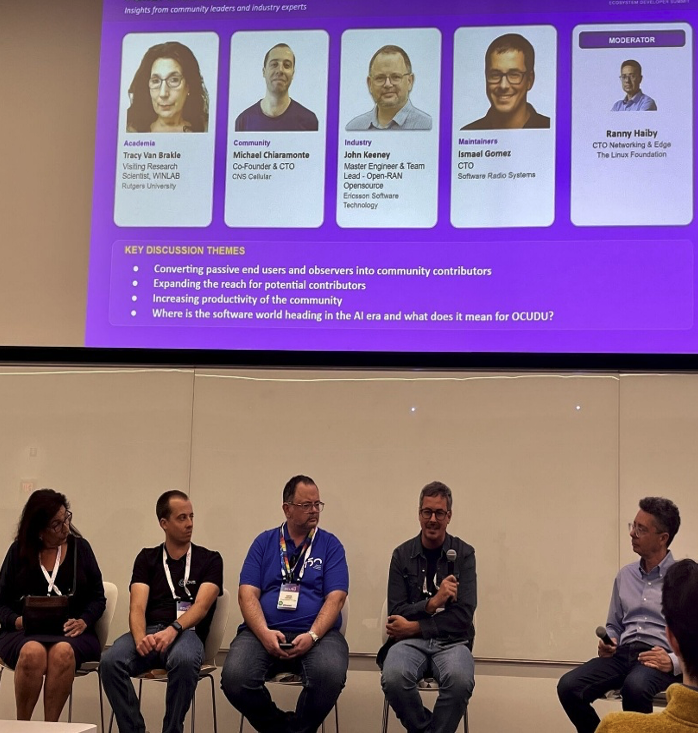
John Keeney, EST team leader for Open-RAN open-source, was invited to participate in an expert panel discussion session about how to help OCUDU grow and mature into an active and robust open-source community. John was joined by Ismael Gomez (CTO of Software Radio Systems), Michael Chiaramonte (CTO of CNS Cellular) and Tracy Van Brakle (WINLAB @ Rutgers Univ.) and moderated by Ranny Haiby (Linux Foundation).
We discussed how OCUDU & other open-source telco initiatives massively reduce the barrier to entry to help spur this research & innovation. But we as a community still have alot of work to do. We spoke about how to convert passive end users and observers into community contributors, how to expand the reach for potential contributors, ways to increase productivity of the community, and where is the open-source software world heading in the AI era and what does it mean for OCUDU. The discussion was lively, with many good ideas and insights, lots of questions, and just the right number of differing opinions.
What we took away
People are already using OCUDU, thanks to the already capable seed-code and ongoing improvements from contributions. The feature set is growing, and the OCUDU community is expanding. There is interest in building field-ready commercial-grade functionality, and focus on using and extending OCUDU for AI-RAN and research. The ambition levels are high, as seen from the excellent keynotes, the presentations and demos. The topic of testing and verification was very popular; as more features land, people want test and verification coverage and robustness to improve, which was good to hear since that's an area we've been working in.
What's next
Another OCUDU summit is proposed for Spring-time 2027, and OCUDU will be well represented at most of the upcoming telecoms, networking and open-source events. We look forward to continuing to contribute in OCUDU as part of our long-standing commitment to open innovation.
Thanks to the Linux Foundation, the Commonwealth Cyber Initiative and Virginia Tech for hosting, and to everyone who came by the booth. The Test Reporting tool is live on the OCUDU GitLab if you want to have a look.